Generative engine optimization
Buyers now ask an AI before they ask a search engine.
Ask for the best linen shirt under 120€: an AI answers from a handful of sources it kept and judged reliable. Being one of those sources has nothing to do with ranking on Google, and few stores have prepared for it.
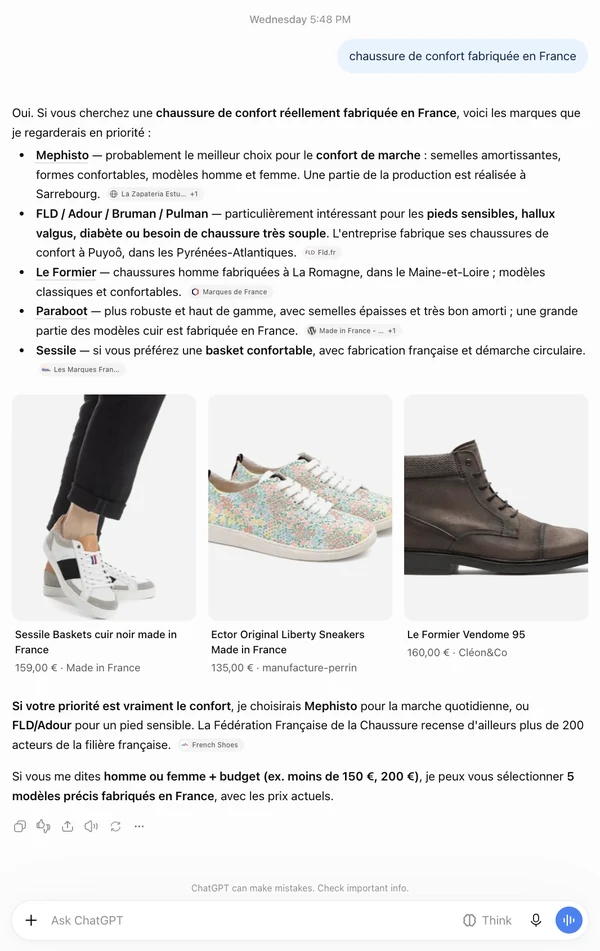
Measured by hand in the answers of
- ChatGPT
- Claude
- Gemini
- Perplexity
Not a ranking. A citation.
A new channel
that cannot be bought, and does not show up in your analytics.
A search engine offers a list and lets the visitor choose. An AI reads the sources, decides, and gives one answer. There is no second page: cited or absent is the whole result. So the work is making your store legible to a machine that reads instead of crawling: sharp answers to the questions buyers ask, structured data that describes each page, and enough mentions elsewhere to be corroborated outside your own domain.
Four steps. You influence two.
Source selection and trust are the two you can move. All of our work goes into those.
“Best linen shirt under 120€ for hot weather?”
The question
Conversational, specific, usually with a budget attached
Your leverage
None
Source selection
The AI gathers the sources it can read and understand
Your leverage
This is where the work happens
Trust
It weighs corroboration: reviews, mentions, consistency between sources
Your leverage
Earned, slowly
The answer
One recommendation, no second page
Your leverage
None
What we will not promise you.
Nobody can guarantee a place in an AI answer, and anyone who promises one is selling what they cannot deliver. The mechanisms are recent, they change without notice, and there is no ranking to display. What we can do is make your store readable and corroborated, then measure your presence on real questions, so you see the change instead of taking our word for it.
Audit, improve, measure.
- 1
Audit
Price. Free, or €900 to €1,500 for the in-depth audit
What ChatGPT, Gemini, Perplexity and Claude say about your brand and your competitors, measured over repeated runs on real buying questions.
You get the questions we ran, how often each tool named you, which brands were named instead, and how your brand was described when it came up. The same questions are asked again later, so the second report is comparable to the first. The in-depth audit runs 20 questions over 10 working days. It adds the sources AI tools rely on in your category and a prioritised roadmap, and its price is deducted from the programme if one follows.
What the free audit contains
- 4 buying questions from your category
- Asked 5 times to ChatGPT, Gemini, Perplexity and Claude
- Your citation rate, the brands cited instead of you, how you are described
- 3 priority actions, as a PDF within 3 working days
- 2
Improve
Price. GEO programme, €3,500 to €6,000 over 6 weeks. Essential programme, €1,500 to €2,500 over 3 weeks.
Our agent set up on your catalogue. Your product pages rewritten so AI tools can quote them while they still sell to a human buyer, with their structured data.
Around the agent, the programme adds pages that answer buying questions and corrects wrong information at the source. It opens your site to AI crawlers, plans your presence on third-party sources and sets up GA4 to measure AI traffic. The before and after is measured on the audit’s questions. For young brands (€250k to €1M of annual revenue), the Essential programme covers AI crawler access and product structured data, with the agent on your 10 to 20 best-selling product pages, measured on the free audit’s 4 questions.
- 3
Measure
Price. Included in the programme. Monthly follow-up, €1,000 to €2,000 / month, 3-month minimum.
GA4 set up to show the traffic that comes from AI tools, and the same questions asked again every month.
In the monthly follow-up, our agent keeps watch. It reworks new product pages as they are added and flags wrong information about your brand. Each month you get a progress report, the work on third-party sources continues, and we iterate on what moved. Part of AI traffic carries no trace of where it came from, so we say each time how much the figure may undercount.
What this looks like on a real store.
Five findings that come up on almost every store we look at. Each one is checked on the live pages before it goes in a report.
| What we find | What it costs | What we do |
|---|---|---|
| A product page that answers none of the usage questions | The AI has nothing to quote on sizing, materials or care, so it quotes a competitor that does. | Answer the buying questions in plain text on the page, where a machine can read them. |
| Structured data missing, or contradicting the page | Wrong markup teaches an AI something false with your name on it. Missing markup leaves the page ambiguous. | Product, offer and review markup that matches what the page actually says. |
| Absent from the comparisons and review sites of your category | A claim only you make is a claim. An AI weighs corroboration, and finds none. | A plan for presence on the sources your category is actually read from. |
| Wrong price or delivery terms repeated by an AI | The buyer reads an outdated figure and either leaves or arrives with the wrong expectation. | Find where the stale information lives and correct it at the source. |
| AI crawlers blocked in robots.txt | The store cannot be cited because it cannot be read. The cheapest possible loss. | Open the crawlers you want deliberately, and say which parts they may read. |
On this subject, from our blog
Written in French.
We did this to our own site first.
This page, and every other page here, ships structured data, a machine-readable sitemap, an explicit policy for AI crawlers and a plain-text summary of what the studio does. You are reading what we would put in place for you.
Where this leads next
- AI agents
The agent that does much of this work. You can run it on one of your own product pages.
Start with a free GEO audit.
We ask ChatGPT, Gemini, Perplexity and Claude 4 buying questions from your category, 5 times each, and send you your citation rate and three priority actions within 3 working days. No call first, nothing owed.